Tree Planting Ceremony
This Saturday, the U.S. Ambassador to Gabon, Cynthia Akuetteh, is supposed to be in Doumandzou for the formal inauguration of the renovated school.
A former Peace Corps staffer, she has shown interest in the project as far back as a year ago when she was awaiting confirmation.
When we first arrived in Libreville, back in January, just a month after she had arrived, she organized at the new Embassy grounds north of the airport a ceremony to honor the two Peace Corps volunteers who died during their service: Karen Phillips and Diana Fillmore. Ambassador Akuetteh arranged to have a tree planted on the Embassy grounds and a plaque with both Karen’s and Diana’s names on it.
During the ceremony, the Ambassador (in yellow below) read a couple of poems, and two of us present spoke about our memories of Karen and Diana. Bob Weisflog made some wonderful remarks about the Peace Corps family. The family was well represented, with four returned volunteers, former staff members and teachers who taught at trainings. The tree will be a living memorial to our friends who never made it home.
Here are a few photos, but you can find more on the Embassy website: http://french.libreville.usembassy.gov/tree_planting.html


What does Doumandzou mean?
You have heard that Doumandzou is the “centre du monde”. But what does it mean. This came up as the cement was being worked as the final surface of the terrace. The goats did a number on the original as you can see, but we were worried. One of the construction inspectors (in red in the photo) was remarking that he didn’t want to get stuck in the fresh cement. That brought to mind the village of Obia in the east of Gabon where we had a training and completed a school. I mentioned that Obia mean “we got stuck in the mud”. I then asked one of the other construction inspectors, Papa Ekabane our host and the biggest player in the village, “What does Doumandzou mean?” He replies “The eagle’s nest.” He pointed out that eagles make their nests in the tops if some of the okoume trees and specifically one in the distant horizon. I of course had to tell them that I used to live in a house called “Crows Nest”, Then I said that i had graduated from a Crow to an Eagle. Last coat of paint goes on tomorrow and then it is patching holes in the roof and touch up and clean up. We should be ready for the ambassador and other dignitaries this Saturday.
Water
We have arrived back in western Massachusetts, leaving Drew and Claire to complete the school, supporting the indispensable effort of Christian, Nico, Nguema and the young men.
While in Doumandzou, we were reminded of how much we take for granted back home. Water is number one on that list.
We each drank about 2 quarts a day, we used almost as much for cooking, more for cleaning, and about 2 buckets for our showers, and more for washing clothes.
There is a well not far from the house that we would tap into for about 6-8 buckets a day. We filtered a couple of quarts each day for cooking, and we had a large supply of bottled water, that was replenished several times. That’s unfortunate because of the empty plastic bottles but it seemed some of them were re-used in a variety of creative ways.
Then there was the water needed for the school construction, to mix the cement and paint, and to clean up. That water came from a stream, with the small children bringing in wheelbarrows the buckets to fill up an oil drum outside the school.
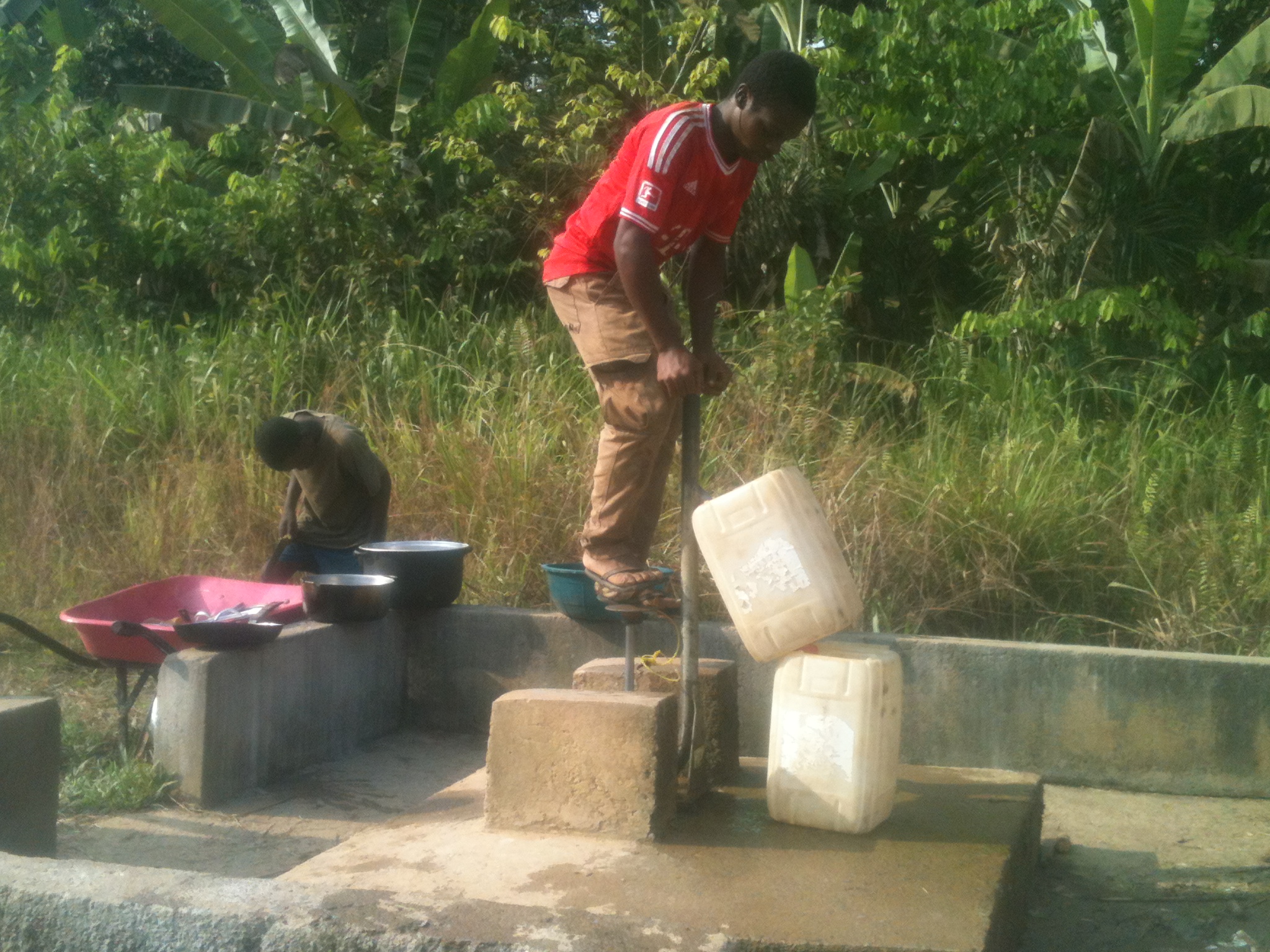
The well is a meeting place. It is normally the job for the young to get water, but we saw mothers and fathers there with their very small children. Whenever we took a bucket up to the well, a young child would inevitably emerge and take over the dance required to operate the foot pump.
There are a couple of streams flowing through the village but we heard of snakes and other animals so we preferred to go to the well.
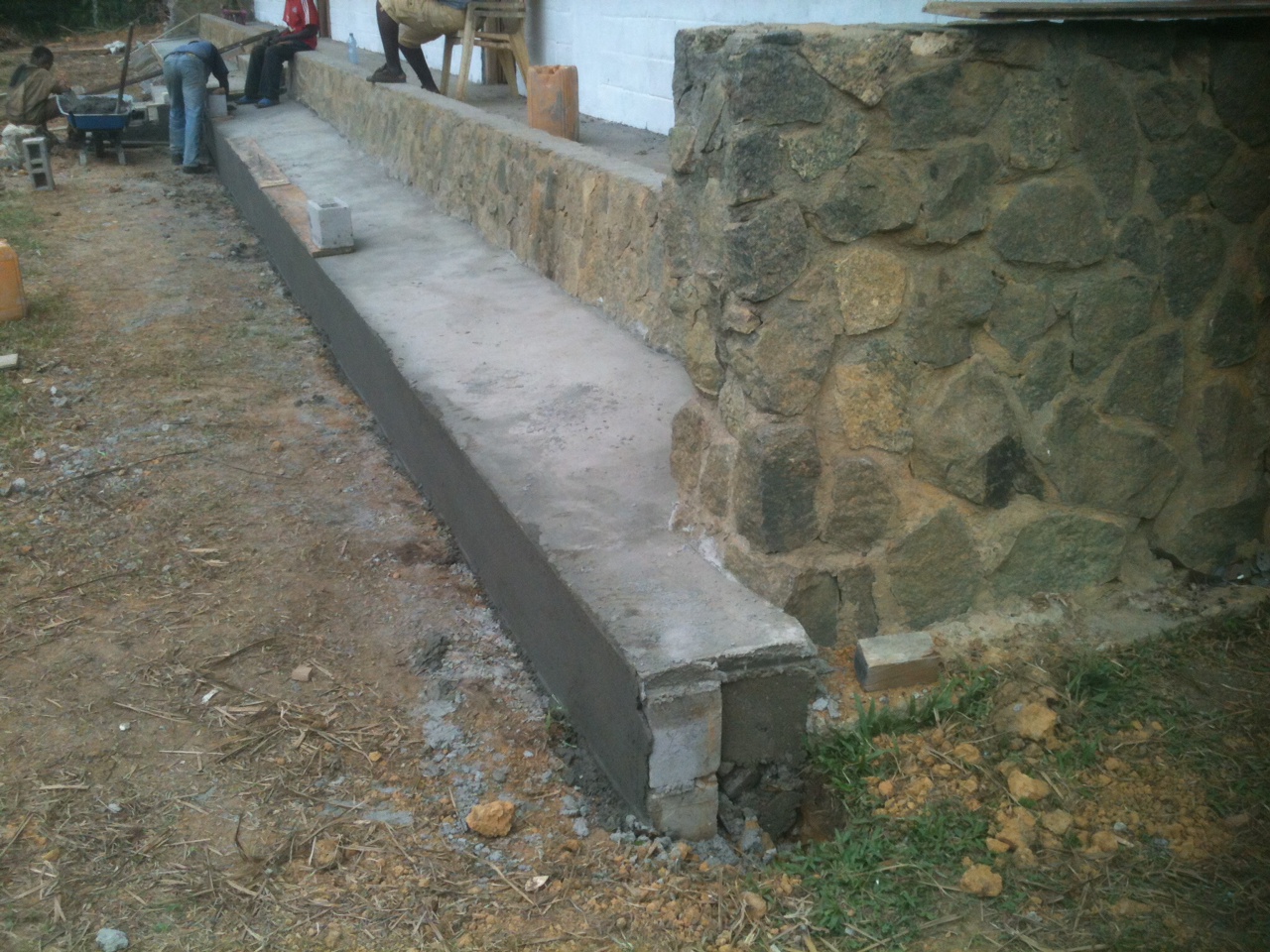
Perhaps water took on such a priority since we were in the village during the short dry season. Normally, big metal drums sit under the roof and collect the run-off from the heavy downpours, leaving a ready supply of water just outside the house. That heavy rainfall accounted for the erosion of the foundation on the school and hence the need to build a terrace under the roof to catch the rain before it hit the ground and caused further erosion.
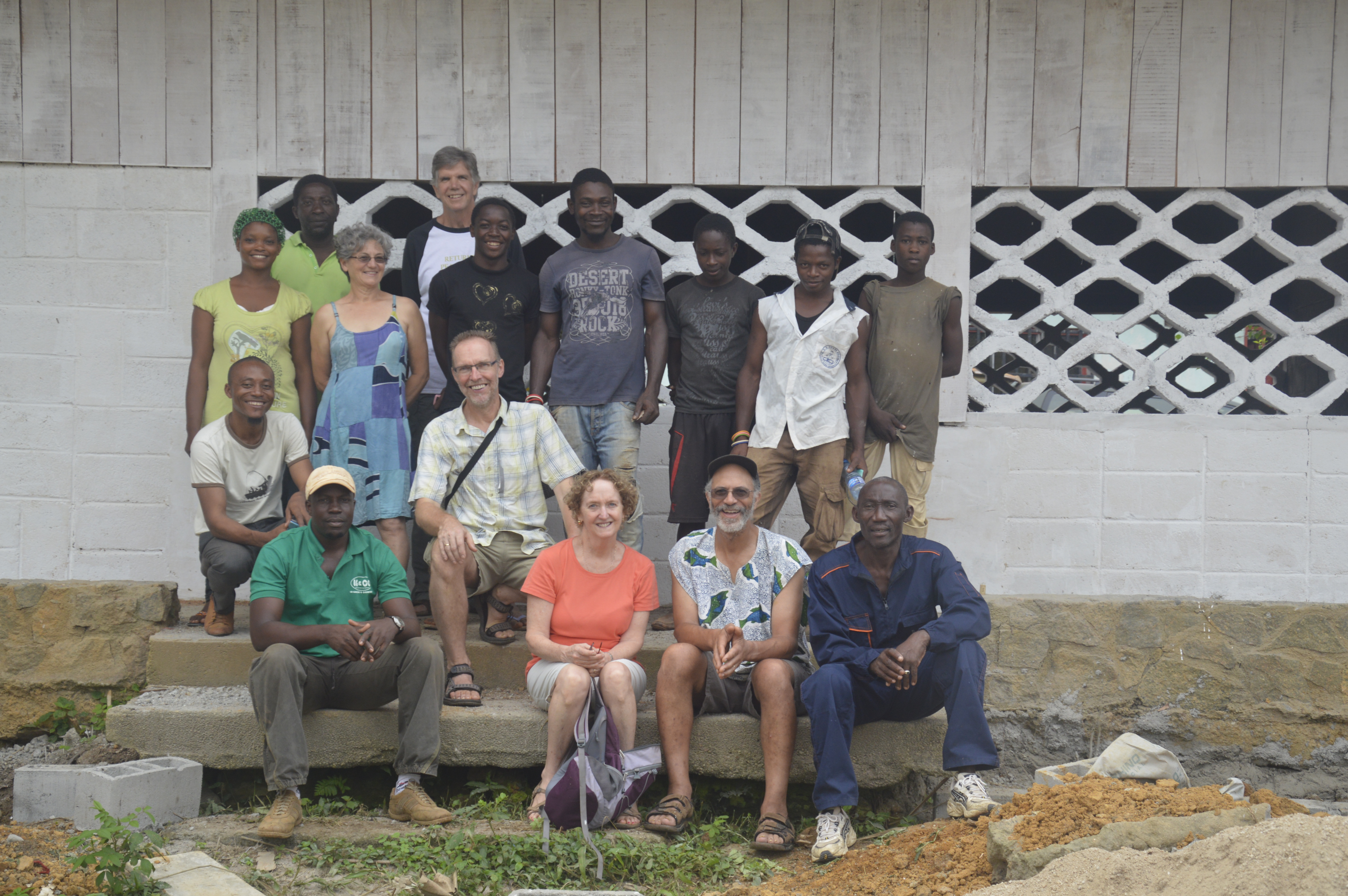
The photos here are of Terrence working the pump, balancing two jugs so that the opening of the top jug fits right over the spout, wasting as little water as possible. There is a photo of the terrace under construction this week, and a group photo of all the workers, taken shortly before Mary, Henk and John joined Bob and Gaston for the ride back to Libreville.
Songo
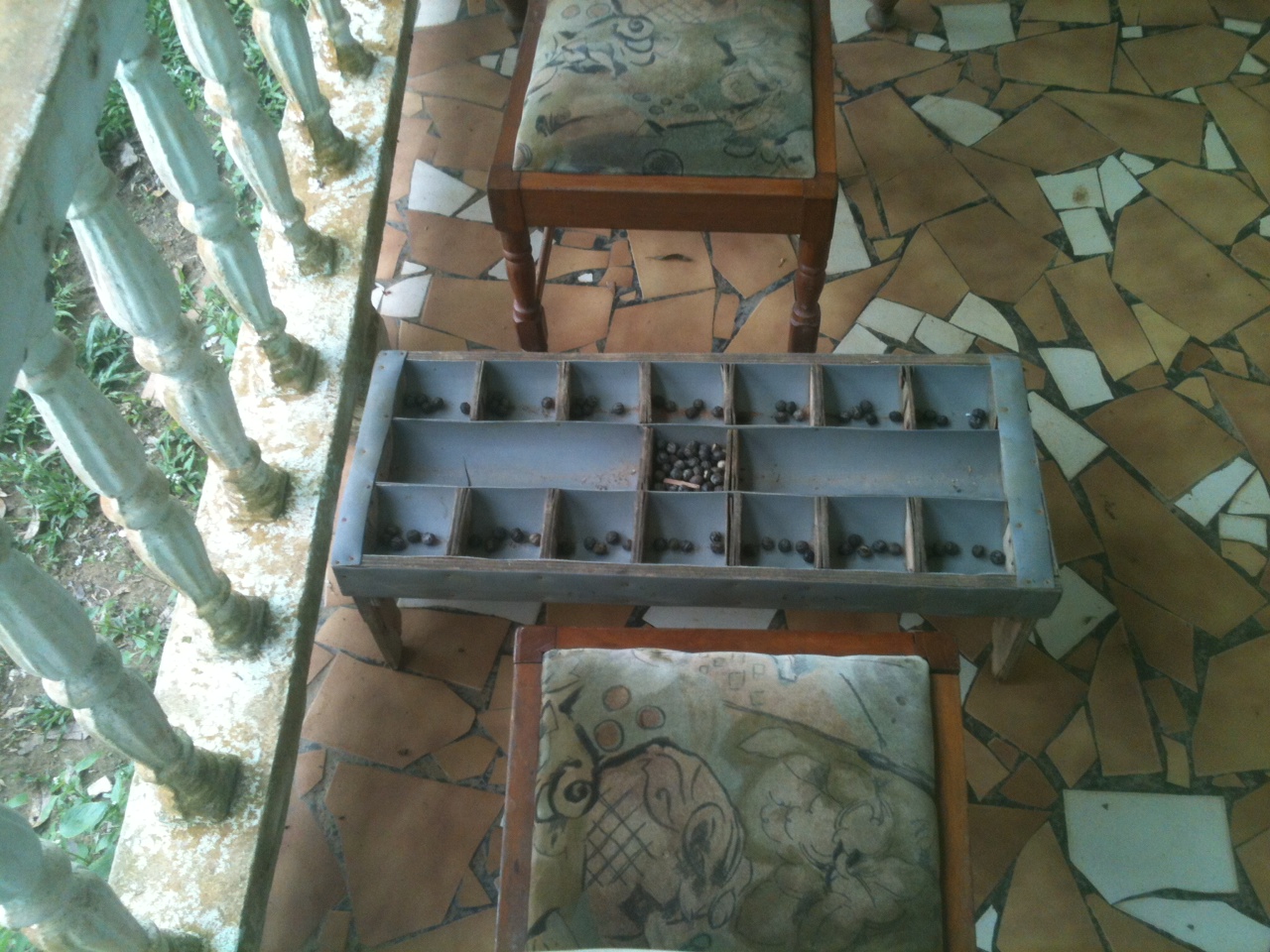
In the various countries of west Africa where I have traveled, I have encountered a variety of games played with beads or seeds and a wooden board with any number of different cavities or “houses.” The name and rules vary depending on the culture-among the Mende of Sierra Leone I recall different rules for a men’s or a women’s game.
Here amoung the Fang of Gabon it is called Songo and as the picture shows there are 7 “houses” per side and each player starts with 35 seeds from a local tree and the object is to capture more seeds than your opponent. It is deceptively simple which leads to very complex strategy. This particular game is located on the veranda of our host and I received excellent instructions, “Play Andre (as I am known here) and see what happens.” I am pretty good at counting, so I thought I had a chance. NOT. I got whipped. But I could for sure have another games as we had seen a similar set in the “corps de garde” (a village meeting house) in Belleville where we walked two weeks ago.
We are in the final push to get the school finished for the inauguration on the14th of Feb which will include the US ambassador and local dignitaries.
There’s still some painting to do (did you know in a pinch, you can thin oil base paint with gasoline?) and renailing the roof where we had replace rotten purloins. We are getting more volunteers from the village so I know we will make it.
Village Walk
I remember my father talking about walking through villages in Italy where his quartermaster company would spend a night. He and his buddy would look for spices in the window and would later return to trade army rations for hidden Italian delicacies. And I recall Jon Anderson or Steve Hyde talking about walking from their house in Obili to the school site and spending sometimes a half an hour due to all the greetings they would receive and give. It’s about getting to know a place and be known in that place.
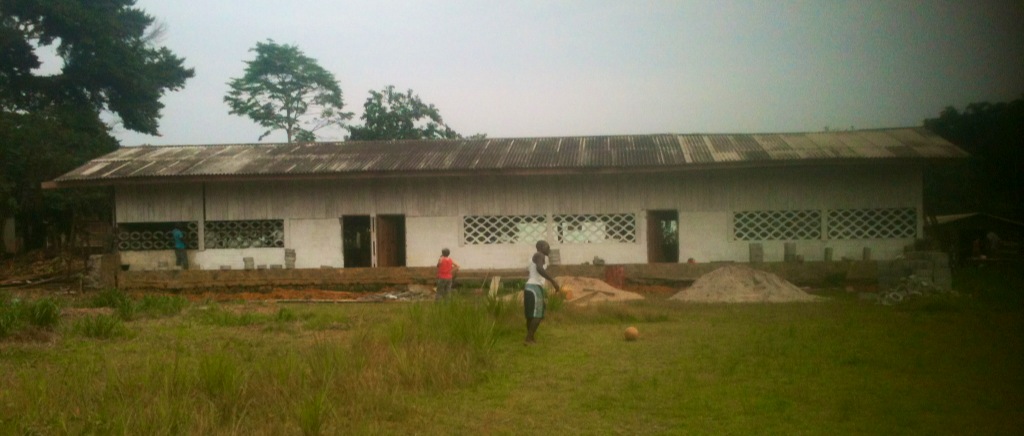
We stay in a place at the east end of Doumandzou and Mad Bum could throw a fast ball from where we are drinking a Regab and hit the school we are rehabbing easily. A walk to the west end of Doumandzou is about 800 meters and it can be magical.
I get and give greetings to folks sitting in front of their houses. I greet people sitting outside of Jean Martin’s house/buvette. They ask where I am going, “Just to the top of the hill where the wire crosses the road.”
And now I am there. No more Doumandzou ahead of me so I turn around. The full moon is rising, an orange in some whispy clouds. Two toucans cry out as they fly over (think geese-just as loud, but slightly smaller. And then the playful voices of kids filling up water for their families at the village pump/well. More questions “Andre what are you doing?” “Just out for a walk.” And so much more.
I must conclude with many thanks to John, Mary and Henk who preceded us here and left this past Monday. Our transition to Doumandzou would not have so easy but for them.
I have to learn to post pictures-next time.
Wrapping up, not quite
Today was the last full day for Henk, Mary and John. We had a few personal things to do before we left. Nguema took us to see the well that Robert uncovered in 1964 and that still supplies a needed source of clean water to the village. We had a few last minute purchases of souvenirs to bring home.
We were all set to find a car to start our journey to Libreville, when we learned that Bob and Gaston decided to drive out to Doumandzou to check on progress and see what remained to be done. They arrived yesterday afternoon to great celebration as they brought some resupplies as well. Bob was so happy to see the upgraded school he drove around the soccer field in his car blasting his horn.
They did a quick inspection on the school and houses while we finished painting the primer on all the windows. Drew and Henk had reinforced the center beams in the school.
Today we had two meetings, one to discuss work progress and the other in the corps de garde to talk about what work remained to be done and the inauguration with the attendance hopefully of the US Ambassador (to great applause). Gaston thanked the village for all they had done to receive us so well. John also thanked everyone saying he was happy that so much had been accomplished with the help of so many people but sad to be leaving his new friends with work still to be done. Gaston pointed out Drew and Claire would stay and continue to work.
Afterwards we took pictures and had a nice big meal, with more than a few beers.
Photos below are of today’s work meeting and of the school as three of us are leaving it, with roof placed on one of the teachers’ houses and handles on the doors of the school. The last photo is of Drew with his contraption to place the beam securely on the center of the roof.
Drew will continue to send updates over the next few weeks to the blog, and we have a couple others on water and children that we can send after we leave.


Adieu nos amis de Doumandzou.
We’re not 25 anymore
Not even 45. But after a few weeks of sometimes back-breaking work, we’re not as exhausted or weary as we were the first week.
Of the five of us here there’s really only one of us with any construction experience. What that means is the real skill work (masonry, carpentry) is being done by our foreman, Christian, his colleagues Nico and Yannick or the guardian of the house where we’re staying, Nguema. A lot of the hard muscle work is done by the young men from the village.
So, you might ask, what is it exactly that we are doing. Quite a bit actually and quite a bit varied. We have never been idle, working six days a week. We started out doing a lot of demolition, scraping and cleaning the old wood that could be salvaged. Mary spent a lot of time treating the new wood with preservative, and we have also done carpentry, replacing rotted beams and putting up the vertical planks. There’s been more than our fair share of organizing the work site, moving around and cleaning the bricks and lumber, and a little clearing.
We have made a lot of progress so far but it didn’t take us long to realize just how dependent we are on our hosts to be able to see the progress we’ve been making. Truly a community effort.
Below are Clair and Mary painting window blocks at the rear end of the school, just behind Nico who is laying them. Also, my gloves after three weeks of work are exhibit A that we have actually been pitching in.


Il faut profiter
I try not to post everyday, but today we had some excitement. We learned in the morning that a bulldozer that belonged to the nearby Chinese logging company would be coming through the village. We heard the magic words in the village “il faut profiter” – You must take advantage. There’s a lot of village life, it seems, wrapped up in those words, taking advantage of opportunities that come up.
Our opportunity today was a bulldozer to push back the forest behind the school and teachers houses. Some great landscaping
About 50 feet behind the teachers houses, a small tin fence appeared. It turned out it had a roof, and looked like a shed. The dozer cleaned out in front of it, and it turns out to have been a three stall latrine built in 1965 by the Peace Corps school construction group. Still standing.


We’re painting!
We passed a threshold yesterday and started putting the primer on the window blocks.
All the windows on the front facade are in, and we need just a couple of more vertical wooden planks to close up the school. The facia boards are up on the front as well. I don’t want to jinx anything, but it looks like we may finish on time.
Tonight, Henk gave out European soccer jerseys to the four young village men who have been helping us. Since Nico once told us he wanted to go to Miami, he got a shirt with Miami Beach on it. Smiles all around.
Sorry about the comments that readers have not been able to read. Try clicking on the blog post that will send you to a different page with the individual post and the comments at the bottom of the post. Lets hope that works.
Cell phones
| If you ask for someone’s contact information, you will be given a cell phone number. If you buy a ticket on the train, you will be asked for your cell phone number. Cell phones are everywhere and unlike New England there is no attempt to disguise a tower in the form of a tree or within a church steeple. And it’s easy to understand. The infrastructure you need to install is minimal. We saw towers with a fence around the base which included solar panels for power. Bingo, no transmission cables to install and maintain, no houses to wire.Most phones that we saw in the village were your basic non-smart phone variety. You can talk, you can text, you can take pictures, you can play music. The young guys working on the school would have their phones and music would be blaring out. I countered with by bluetooth speaker playing Santana, Grateful Dead and Canned Heat.
The phones are also a method of transfering money. It is so easy to walk into tiny places either in villages, towns or cities and hand bills to the merchant (the same one selling the soap or the mattress or the drinks) and then you get a message on you phone that your data has been increased or you have a certain sum. Henri, the guy we met in Okandja, was spending a lot of time making sure a message got through to his brother in Cameroun, transfering money to him. He had to try several times but eventually it did go through. The drawback–every silver lining has a cloud–is that I haven’t seen cell phone ediquette developed, or been enforced. Taking while driving, answering the phone while inspecting travel documents, or answering and then talking on the phone in the middle of a meeting is commonplace. But it did allow me to speak with Bernadette, our former cook in Lekila, when I was in the village. Her sister, Ambrosine, was talking with me as we were walking around the village and then hands me her phone and says it’s Bernadette calling from Libreville. All I could do is smile. (Drew Howard) |
 Encore de la Paix