Teachers’ houses
Next to the school were two structures, both abandoned to the workings of nature. One was a single family house, and the other had two residences. These were also built in 1965 with the original school to house three teachers and their families.
It’s unclear when the last time anyone inhabited these structures, but they were being taken over by the forest, parts of them held up by the vines that grew through them.
Our first priority all along had been the school but we thought that with just a bit more fund-raising we could tackle these houses, that were such an eyesore in the middle of the village. We had forgotten but the word for ugly here is “villain.” These houses were called villain.
Underneath the rot and rubble, though, we found an amazingly sturdy structure, that has impressed the local builders. Some of the wood is incredibly strong and immovably attached to the concrete. Certain design elements went into the entrances to make them more livable.
We realize how important it was to include these houses in the overall project, for the aesthetics of the upgrade, but also as a way to help attract those responsible for the schooling in the other building.
Photos below are before and now, and of David who climbed on one of the roofless structures to cut the vines with his machete. Soon will come an “after” photo when they are completed.


Live from Doumandzou
It’s Saturday night.
Some days work is slow and small. Others, progress is visible from hundreds of meters away. We had both kinds of days this week. But, today was one of the latter.
Christian, our chef, arrived yesterday with the last order of wood, and then we took advantage of the truck to get our last load of sand, at a stream just a couple of kilometers from the village.
With all the materials on hand, the worksite turned into a six-ring circus of activity today. The biggest step forward was the laying of the “cloistered” cement block windows in two of the classrooms. At the same time, a trench was dug in front of the school for the new terrace to catch the water off the roof and save the school’s foundation. The teachers’ houses had been cleared and cleaned of all the encroaching forest, and we have started rebuilding the roof structures. The new wood was treated, and window blocks were cleaned up, readied for placement. We probably had 16 people working at the site today.
Two if those 16 were Drew and Claire who arrived earlier in the week. Bienvenue.
Photos below are of Christian laying the windows; of Nico in front of the terrace/trench and of Drew, Christian and the truck driver getting sand “en brousse.”
We are not far from starting to paint. Now that’s enough excitement got a Saturday night.
We have received some terrific comments, but to see them all, you’ll have to scroll all the way down to the bottom of this page, after all the posts.


Archaeology
Our friend Cliff who was a construction volunteer in the Peace Corps and has built several houses (including helping rehab our house in Pittsfield) would mark his name somewhere in the inner structure of the building, a sign for future generations.
So, we half expected to find some traces of the original builders as we have been taking apart the school and teachers’ houses. After working in one of the classrooms, taking down the rotten beams, scraping and brushing the solid ones, making bricks, we would pause and stare at the walls, out the windows, catching our breath in the heat of the day.
And then we saw it, right where the blackboard had been hung. The numbers 1, 9, 6, 5, and the letters JA and then bigger letters PD.
JA is of course the man who has approached near legendary status in the village, Jerry Anderson, the team leader of the group in 1965 that built the school. Near legend because we hear his name often, and not just in connection with the school. Several people have told us he drilled a hole in a rock and found a source of clean water, that continues to run. There he was, behind the blackboard, reaching across the 50 years to send us a message.
We are not sure what the PD stands for so we welcome any input from the earlier group of volunteers.
The first picture is of Arcel and Jean-Baptiste making bricks in the classroom. Hope you all can make out 1965, JA and PD in the next photo.


We remember Dan.
Food
We could write a book about what we’re eating, how we’re eating, when we’re eating. Our book would have a lot of pictures but unfortunately we haven’t taken a lot.
First, and foremost the kindness of strangers. Our hosts where we are staying and the people who look after their house have been extraordinarily generous preparing meals that have appeared when we come back from work. The town elder, Papa Ekabane, and his joyous wife Esperanze (where Bob and Claire and Drew are staying) have regularly put on Thanksgiving type meals with fish, antelope, chicken and hedgehog type game. But it’s the various preparations of cassava and corn that our really wonderful. Our favorites might be fish and manioc leaves or fish and another leaf called fornol or a corn porridge.
People come to the house or to the worksite and drop off pineapples or papaya, plaintain and bananas. In season now are atangas, a small, avocado type fruit that is quickly boiled, salted and great with beer. There was one woman who saw us out walking and called us over to her very humble home to give us a dish she had prepared.
Second, we have a regimen of food we brought with us which is pretty boring but fills us up and is relatively easy to prepare. This includes rice and canned lentils, tomatoes and fish. Breakfast is routine, consisting of oatmeal, bread/ when find it, fruit, coffee and juice. Our Peace Corps will be happy to remember the Nescafé and lait sucre and canned sardines and mackerel continue as staples.
The photos below are of a meal at Papa Ekabane’s with Gaston, Bob, Mary and Henk. The other is Gabon meets France, baguettes and atangas.


Temporary school
January seemed like an ideal time to come work on the school because it’s the short dry season in Gabon. No rain. However, we also worried that we would be interrupting classes in session. Some of us vaguely remember a loose calendar with students drifting back slowly. We knew we couldn’t be working on the school at the same time that students were in the classes.
What we didn’t count on was an enterprising primary school teacher by the name of Roland. On Monday, he returned from the provincial capital where he had gone to submit the results of the first term.
The village had identified an unfinished building for his classes during construction. By Tuesday morning he had cut the tall grass in front and around the building, moved the blackboards and school bell, and had the students carry the heavy desks to the temporary school. He divided the students into morning and afternoon sessions.
When we stopped by Wednesday afternoon, he was in the middle of a lesson about telling time using a clock with hands, with a picture he had drawn on the blackboard.
Students missed one day of class.


It’s Friday! TGIF
We thought that meant the start of the weekend but found out last night that people work Saturday as well. TGIS.
For only a week of work, there has been visible progress. After clearing and demolition that continues, we will have finished making all the window blocks, and the vertical planks above the windows will run across the whole front of the buildings. All the doors and frames have been placed.
At any given time, there are as many as six people working with the three of us: Christian, the foreman, Nico, his partner, and four strong, young teenage boys from the village: Arcel, Terence,Jean-Baptiste and David. The latter four have been doing the real muscle work, including brick-making which John helped out on one morning. Mary continues to treat the wood and Henk pitches in everywhere, specializing in demolition. Nguema who is our host comes up to help each day doing some masonry.
We have settled into routines, starting around 8am, breaking after noon, and then returning for a few hours in the late afternoon. Christian is on a slightly different routine arriving early and then returning for breakfast and working through until five or so.
I should add a number of the primary school children, who are on double shifts, hang around the site and pitch in a lot.
Upcoming blogs on food, the temporary school, and a bit of archaeology we uncovered.


Work starts
Monday was the first full day of physical labor, what we had come for, what all the months of preparation had been leading to.
First job was moving the 400 cement blocks that had already been made and cleaning out the classrooms. At the same time, demolition started, removing the doors and windows and rotted beams and rafters. A lot of help from school kids and residents.
Our foreman (chef de chantier) Christian oversaw two separate deliveries of wood and sand. Each took more than twice as long as expected with trucks breaking down and getting stuck. Still, he persisted and the load of sand rolled in to town shortly before dark last night.
I should add our new best friend is Aspirin. Sore muscles.


Corps de Garde
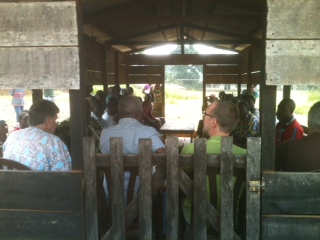
Yesterday we had our formal introduction to the village.
Every village has a small rectangular hut strategically placed near the road and in full view of the entrances to the village. It is called the Corps de Garde and that’s where we met yesterday. (Photo below)
Going back and forth between French and the local language, Fang, Gaston presented the history of the school built by Peace Corps 50 years ago. He introduced the four of us by name and explained our purpose. He asked for help from the village in cleaning up the school site and in taking care of us. The former Deputy of the National Assembly, Ekabane, and the Chef de Canton, also spoke.
John, in his broken French mixed up with remnants of Spanish, gave a little background to Encore de la Paix, saying that Gabon changed our lives 35 years ago and that ever since we left, the country has been in our minds and our hearts. We wanted to do something to say Merci to the people of Gabon. He thanked Bob and Gaston for all their arrangements and he talked about the special connection between the town of Woerden in the Netherlands where Henk is from and Doumandzou. By chance the town next to Doumandzou up the road is called Holland.
Bob also spoke and talked about the original group who built the school mentioning by name Jerry Anderson. Gaston passed out the photos we had brought and one woman wanted to take the one of the young Jerry playing the drum home with her.
Our foreman, Christian, came and we went over the work plan for our first day.
Au village
A long drive Friday from Libreville to Doumandzou. The road was good, paved all the way to Mitzic. Our indispensable guide Bob Weisflog was at the wheel. We stopped in Ndjole for a lunch on the side of the road for chopped beef and fried plantains.
In Mitzic we made a couple of courtesy calls, meeting the President of the local assembly who remembered his English teacher, Jimmy Jones.
We arrived au village shortly after dark and are staying at the home of Gaston Biyogo. A wonderful host.
Today was setting up and organizing a little. We toured the school and mapped out in broad terms the work ahead. About 400 cement blocks have already been made.
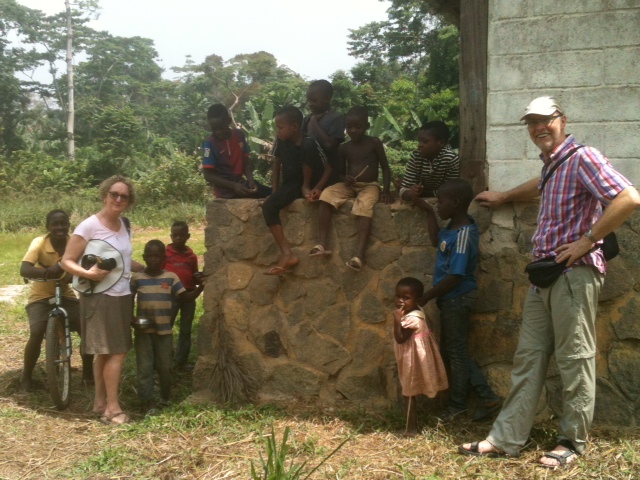
We have met village elders, all pleased we are here. We showed the photos of the school under construction in 1965 along with Jerry Anderson and a few remembered him, calling him Gerald, en francais.
The photo here is of Mary and Henk at the school.
Dateline Doumandzou, le centre du monde, in the words of our hosts. 1pm GMT.
- ← Previous
- 1
- …
- 5
- 6
- 7
- Next →
 Encore de la Paix